

Inside the Exercise
Tips for response and recovery organisations and NSW SES pilot incident management exercise case study.
Author Jade Busoletti
The disaster landscape across Australia is changing, with increasingly intense and compounding events stretching local governments and emergency management agencies. Continuous improvement through things like response and recovery exercises are one of the most effective ways to be ready for what’s ahead. Done well, exercises create a safe space to test people and processes under pressure, understand how teams realistically operate, and turn real-time insights into practical improvements.

For exercises to be meaningful, they need to be thoughtfully designed where the content is grounded in reality, while still pushing teams to respond to complex, high-impact scenarios. When teams practise in conditions that reflect the pressures and uncertainty of real events, they build confidence, strengthen coordination, and gain a clear understanding of what’s working, and what can be improved.
Achieving real value from an exercise comes down to getting a few key elements right.
Here are a few things to consider for your organisation:
- Set clear objectives from the outset, along with how success will be measured.
- Well-defined objectives help shape the exercise design and ensure discussions remain focused on the areas that matter most.
- Design realistic scenarios that are tailored to organisational risks, responsibilities and operating environment. Realistic scenarios help participants to connect with the exercise, encourage meaningful discussion and decision-making under conditions that mirror real events.
- Challenge participants while setting them up for success. Exercises should test a range of skills and capabilities without becoming overcomplicated and inaccessible. Providing clear pre-briefing materials and preparatory sessions can help all participants engage confidently and contribute meaningfully, regardless of their level of experience.
- Exercise the transition from response to recovery. Effective handover of information, decisions and emerging community impacts is essential to supporting relief and recovery efforts. Exercising these arrangements helps ensure responsibilities are clearly understood and recovery partners are equipped with the information they need to continue supporting impacted communities.
- Use an independent facilitator and liaison officers to run the exercise. This frees up participants to stay fully engaged, while ensuring the exercise is guided objectively and runs smoothly.
- Build in a hot debrief to capture immediate reflections and lessons while they’re still fresh. Taking time to reflect immediately after the exercise helps preserve observations and identify improvement opportunities that may otherwise be forgotten.
- Follow through after the exercise by agreeing on actions, assigning ownership, and putting simple processes in place to track progress and embed improvements. Incorporating action points and processes into future exercises can validate whether learnings have been effectively addressed.
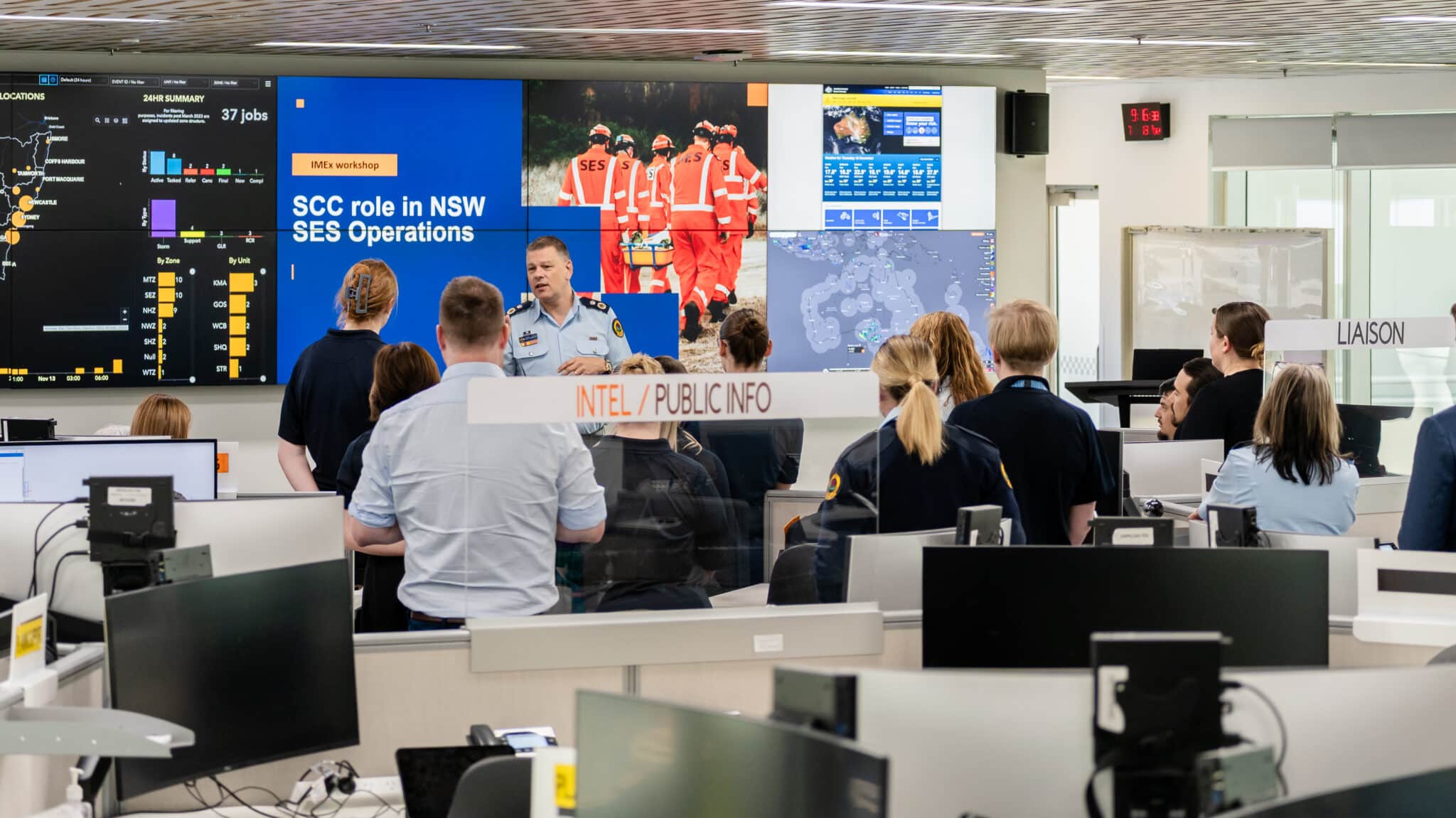

Case study | NSW State Emergency Service pilot incident management exercise
Working collaboratively with the NSW State Emergency Service (NSW SES), Yellow designed and delivered a pilot incident management exercise within the State Command Centre (SCC).
The NSW SES was seeking realistic upper-limit exercising and training for unimaginable events, with the intention to increase capability by testing their functions and incident management teams by looking at multiple zones and across multiple areas of operation, in a safe space environment.
From response through to recovery, the exercise aimed to strengthen incident management team capability to manage complex, multi-event emergencies, capturing lessons and insights that could inform future state-wide exercising.

“It’s really important that response agencies continue to increase their capability by testing their functions and their incident management teams in these safe space environments. You want to design an exercise in a way that challenges participants but not enough to overwhelm them to the point where they’re not able to learn. If an environment is too chaotic it often impacts a participant’s capability of learning within the exercise, which is a key point of doing the exercise.”
– Jade Busoletti, Yellow Senior Consultant
Through a series of half-day workshops and a full day live incident management exercise, teams were effectively prepared in a low-stress environment. The full-day exercise provided the NSW SES with an opportunity to trial the end‑to‑end delivery of a functional SCC exercise, from initial activation through to situational analysis, government reporting, and a simulated transition from response to recovery.
“The opportunity to do this training, to bring new people on, to familiarise them with the systems and the processes means we broadened our capacity as an agency. Which means we’re there to help the community, when the community needs help.”
– Daniel Austin NSW SES Deputy Commissioner
The NSW SES pilot incident management exercise demonstrated how the critical response and recovery systems and processes operated, while providing essential information on future incident management exercising within the agency.